
Uncategorized

Australian Christmas Spending: 18 Key Statistics

Christmas is Australia’s biggest shopping season, and the numbers are staggering. Over 9 million Australians buy gifts for friends and family each year, with total festive spending reaching approximately $24 billion. What A Sleep commissioned a survey of 500 Australians to better understand Christmas spending habits, budgeting approaches, and gift preferences. Combined with data from national retail forecasts and consumer surveys, here are 18 key Christmas spending statistics every Australian should know.

Australian Christmas Spending 18 Key Statistics
Australian Christmas Spending: 18 Key Statistics

Key Christmas Spending Statistics at a Glance

  • Australians spend an average of $1,160 per person over the Christmas season, up from $1,012 the previous year, primarily due to inflation
  • Total Australian Christmas spending reaches $24 billion, up 3% year-on-year
  • 20% of Australians plan to reduce Christmas spending due to inflation and the rising cost of living
  • 75% of Australians will use mobile devices for at least some holiday shopping
  • 22% of Australian consumers expect to incur holiday debt
  • Gifts account for the largest share of the Christmas budget at $680 per person (58%), followed by travel ($220) and food and alcohol ($190)
  • Parents spend an average of $289 per child on Christmas gifts
  • 71% use personal savings to fund Christmas spending; 22% use credit cards; 7% use buy now, pay later services
  • $4.4 billion is spent on unwanted Christmas gifts each year in Australia
  • The average Australian spends 14 hours shopping and buys gifts for 9 people at an average of $71 per gift

Australian Christmas Spending Trends: 18 Key Statistics

1. Average Christmas Spend Per Person

Australians plan to spend an average of $1,150 on Christmas gifts, travel, food, and other holiday expenses,s a 9% increase from the $1,012 spent the previous year. Inflation is the primary driver of this increase. With $24 billion in total projected spending, Christmas remains Australia’s most commercially significant annual event.

2. Average Holiday Spending Per State

New South Wales leads all states with an average Christmas spending of $1,345 per person, generating $7.4 billion in total holiday spending. Victoria follows at $1,310 per person ($6.7 billion total), Queensland at $1,225 ($4.7 billion), South Australia at around $1,100 ($2 billion), and Western Australia is the most conservative at $920 per person.

3. Mobile Shopping Is Now Mainstream

46% of Australian consumers plan to use mobile devices as their primary channel for holiday gift purchases, a 60% increase compared to the previous year. Meanwhile, in-store shopping has declined 30%. This shift accelerated during the pandemic and has maintained momentum, with mobile commerce now rivalling traditional retail in total Christmas transaction volume.

A Family Shopping Together at the Mall

4. Hybrid Shopping Dominates

According to the Inmobi study, 46% of Australians will shop via mobile, 42% in physical stores, and 12% via desktop websites this Christmas. Australians are not choosing one channel over another; they’re using all three, depending on the category and convenience. This hybrid approach reflects a broader global shift towards omnichannel retail behaviour.

5. Cost of Living Is Curbing Spending for Some

Despite overall spending growth, 20% of Australians say they plan to reduce their Christmas budget due to inflation and rising living costs. At the same time, 33% plan to spend more and 47% expect to maintain last year’s level. This split reflects the uneven economic impact of inflation across Australian households.

6. Holiday Season Drives 24% of Annual Retail Sales

The Christmas and holiday season accounts for roughly 24% of total annual retail revenue in Australia. Total retail spending during the period reached over $64 billion, a 3% increase year-on-year. For many retailers, the six-week period from late November to early January is their most critical trading window.

7. Gifts Are the Biggest Christmas Expense

Gifts make up 58–59% of the average Australian’s Christmas budget, at approximately $680 per person. Travel comes second at 19% ($220), food and alcohol third at 16% ($190), and non-gift items account for the remaining 5% ($60). For households with children, the gift portion is significantly higher.

8. Millennials Spend the Most

Millennials (aged 26–41) are the most generous holiday spenders, averaging $1,350 per person. Gen X (42–56) follow closely at $1,235, Gen Z (17–25) average $1,020, and Baby Boomers (over 56) are the most budget-conscious at $800. Millennials’ higher spending reflects both their peak earning years and their tendency to prioritise experiences and social gifting.

9. Gift Cards Are the Most Wanted Gift

40% of Australians say they hope to receive a gift card this holiday season, making it the most requested gift category. This is followed by clothing (20%), cash (19%), experiences (9%), and tech or homewares. Gift cards’ popularity reflects a preference for recipient choice, particularly useful when buying for teenagers and young adults.

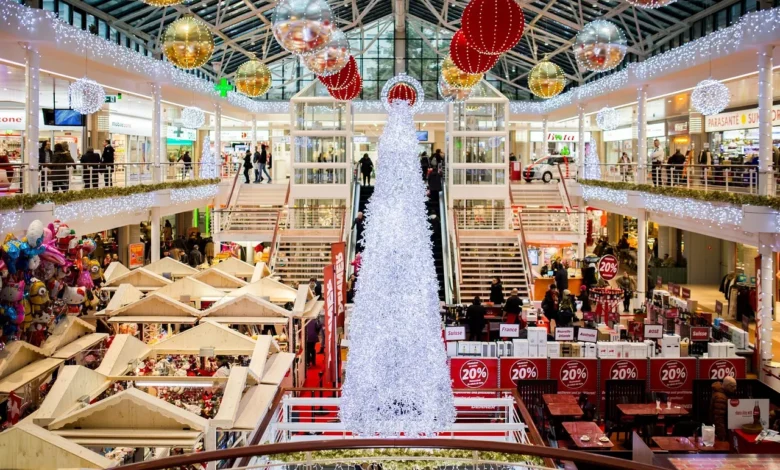
A Shopping Mall Filled with Christmas Decorations

10. Price Is the Top Gift Selection Criterion

54% of Australians identify price as the most important factor when choosing a gift for someone. Gift convenience (18%) and speed of delivery (14%) are the next most cited factors. With one in four Australians planning to shop during Cyber Week sales, it’s clear that value-seeking behaviour is central to Australian Christmas shopping culture.

11. Savings Remain the Primary Funding Source

71% of Australians fund their Christmas spending from personal savings, higher than the equivalent figure in the US (64%). 22% rely on credit cards, and 7% use buy now, pay later (BNPL) services like Afterpay, a 34% increase from the previous year. The growing BNPL share reflects both its mainstream adoption and financial pressure on some households.

12. Consumer Goods Prices Have Risen 6.8%

Inflation has pushed consumer goods prices up 6.8% compared to the previous year, with fruits and vegetables rising 18.6%. Despite these pressures, only 20% of Australians say they will reduce their Christmas budget, suggesting Australians are largely committed to maintaining their gifting traditions even as costs rise.

13. Women Spend 39% More Than Men on Gifts

Women are expected to spend 39% more on Christmas gifts than men, averaging $730 compared to $520 for men. Women also tend to shop earlier, purchase for more people, and are more likely to buy multiple smaller gifts rather than a single large item. This gender difference is consistent with broader consumer research on gifting behaviour.

14. Most Australians Start Shopping Early

32% of Australians aim to complete all Christmas shopping by the end of October. A further 35% finish by November. Only 29% shop in November and just 6% leave it until December. Early shopping behaviour reflects a desire to avoid price increases, stockouts, and delivery delays, concerns that became particularly acute following pandemic-era supply chain disruptions.

People Enjoying Food and Drinks in the Mall

15. Gift Cards Are Also the Most Popular Gift to Give

51% of Australians plan to give gift cards as presents this holiday season. This aligns with the 40% who say they want to receive them. After gift cards, board games and puzzles (20%), cash (15%), and electronics (9%) are the most popular categories. The consistency between giving and receiving preferences makes gift cards the most efficient gift choice in Australia.

16. 22% of Gifts Will Be Unwanted

An estimated 22% of all Christmas gifts received will be unwanted or unnecessary by the recipient. This translates to approximately $4.4 billion in wasted spending annually across Australia. Clothing and household items are most often cited as unwanted; books and toys also feature. Unwanted gifts are typically thrown out, returned, or regifted.

17. Hospitality Is the Fastest-Growing Category

The hospitality sector, including dining out, travel, and socialising, is expected to see a 16% increase in Christmas spending, with $9 billion projected for the category. This post-pandemic rebound reflects a strong consumer preference for experiences over physical goods, particularly among younger Australians who value social events and travel.

18. Free Shipping Is the Top Priority for Online Shoppers

52% of Australians say free shipping is the most important factor when choosing an online retailer at Christmas. Research from Sitecore found that the average Australian is willing to pay up to $9 for shipping, but that threshold drops sharply during sale events. Retailers offering free shipping thresholds see significantly higher conversion rates during the holiday season.

Conclusion

Christmas spending in Australia is a $24 billion event shaped by inflation, mobile commerce, early shopping behaviour, and a consistent preference for gift cards. While cost-of-living pressures are pushing a minority of Australians to cut back, the majority are committed to their festive spending traditions. Understanding these trends can help both consumers budget more effectively and retailers plan for the season’s demands.

Related Articles

Related Articles

Leave a Reply

Your email address will not be published. Required fields are marked *

Back to top button