
You’ll need to patch an air mattress at some point. You can’t avoid it. Even the smallest hole can turn a firm bed into a flattened mess, and waking up on the floor is a pain in the neck (literally). This guide covers how to find the leak and how to fix it for Australian readers.
There’s no reason to throw out your air mattress when it sags or leaks. You can repair one with little effort and time. We will show you a few DIY ways of finding and patching your air mattress, with or without a patch kit. You can go back to sleep quickly.
Table of contents
- How to Patch an Air Mattress? 3 Easy Way
- How to find a leak in an air mattress?
- How to Repair a Leaky Air Mattress With a Patch Kit
- How to Repair a Hole in an Air Mattress without a Patch Kit
- How to extend the life of your air mattress:
- Wrapping up
How to patch an air mattress: three easy ways
Every repair follows the same three steps, whatever materials you use. First, find exactly where the air is escaping. Second, prepare the surface so the repair can stick. Third, give the fix enough time to set before you put any weight on it.
Most failed repairs go wrong at the first or second step. People patch the wrong spot, or they stick a patch over dust, moisture or the fuzzy flocking that covers many air beds. Slow down at the start and the rest is simple.
The easiest route is a proper patch kit. If you don’t have one, a few household items can hold the mattress together for a night or two. Both options are covered below, along with ways to track down a leak that refuses to show itself.
Why air mattresses leak in the first place
Knowing the usual weak points saves time. Air mattresses are made from flexible plastic, commonly vinyl, joined with welded seams and fitted with a valve. Each of those parts can fail in its own way.
Seams can separate under strain, especially when a bed is overinflated or loaded unevenly. Valves can sit loosely or wear out. Built-in pumps add more joins and more places for air to creep out. The plastic skin itself can be punctured by something sharp, or it can slowly crack and dry out if it has been stored badly.
A slow leak is often a loose valve rather than a hole. A sudden flat bed is more likely a puncture or a split seam. That difference is worth keeping in mind before you start spraying water around the room. If you’re also wondering about regular use, our piece on sleeping on an air mattress every night explains why a bed built for occasional guests wears faster under daily use.
How to find a leak in an air mattress
Locate the hole on your air mattress. This may seem easy, but it can be tricky. The hole might not be noticeable if it is small.
Most methods for finding a leak can be messy. Before you try any of them, take this first step.
1. Check for the obvious
Most air mattresses leak at the valve, seams and built-in pumps. You can save yourself a lot of work by paying attention to these areas first. The valve is the most likely culprit, and it may be loose or improperly inserted onto the stem.
Push the valve fully home, inflate the bed again and leave it for a while. If it holds, you’ve just solved the problem without any glue. A bed that goes flat again only overnight can still have a tiny hole, so use the following methods if the obvious areas don’t give you an answer.
2) Use dish soap
For this method, you will need dish detergent, water, and a spray bottle. You can also use a sponge or wet rag.
Mix the soap with water in a spray bottle. If you don’t own a spray bottle, dip a wet sponge or rag into soapy water and wipe it over the surface.
The air leak is located where you can see little bubbles. Mark the spot with a permanent marker and deflate the mattress before you patch it up. Marking matters because the bubbles vanish once you wipe the area dry, and a small hole is hard to relocate on a large, flocked surface.
3) Immerse your air mattress in water
First, inflate the air mattress partially. Submerge your air mattress in a bathtub or pool filled with water. Be sure to close the valve before you dip your mattress into the water.
Most manufacturers don’t recommend this method, as you could cause more damage to the air mattress. Check the instructions on the label before you begin. In my view it’s the method to keep for small items or as a last resort, because a full-size bed is awkward to handle wet.
4) Use a garden hose
To use this method, you will need a garden hose, water and a wooden surface on which to place the air mattress.
Place your air mattress on a wooden floor. Cover the wood with vinyl or plastic cloth to protect it from the water.
Connect your garden hose with a source of water and begin spraying the mattress. Move slowly, starting with the valve and working around the mattress. You can miss bubbles in a split second, especially if the hole is small, so work in small sections and watch each one before moving on.
5) Use tissue paper
You can use foil, single-ply paper towels or a napkin to perform the tissue paper trick. Inflate the air mattress first. Then move the tissue around the mattress slowly, keeping it close to the surface.
Begin with the valve and seams you checked in the first step, and then proceed to the remainder of the mattress.
Flip the mattress over and repeat the process on the other side. Watch for air movement in the tissue and listen for hissing noises. These signs indicate that there is an air leak. This is the cleanest method of the five, because nothing gets wet and the light tissue flutters at even a faint stream of air.
Now you need to fix the leak. Use any of the following methods.

How to repair a leaky air mattress with a patch kit
Patch kits are small sets that contain glue, sandpaper and patches. They can be used to repair bike tyres, tents and air mattresses. If you don’t already have one, you can purchase a patch set at any outdoor store.
Use a patch kit to repair your leak:
- Deflate your air mattress completely.
- Remove the felt or flocking with sandpaper until only plastic remains.
- To remove dust or debris from the area where the leak is occurring, use soapy water.
- To cover the entire area, cut your patch at least 1-2 centimetres larger than the hole.
- Follow the instructions on the glue package and apply the glue over the hole.
- Press down on the patch for at least 30 seconds to ensure it’s firmly attached.
- Inflate the mattress and check if it is repaired. Let the glue set for three hours.
The flocking step is the one people skip, and it’s the reason many patches peel. Glue grips bare plastic far better than it grips fuzz. Let the area dry fully after washing it, too, since moisture trapped under a patch weakens the bond.
If the bed needs reinflating while you test it, our guide to inflating an air mattress without a pump has options for when the built-in pump isn’t up to the job.
You can create a patch kit at home by using a shower curtain or plastic that is malleable. Cut it with rounded corners, as square corners tend to lift first.

How to repair a hole in an air mattress without a patch kit
These are stopgaps. They can get you through a night with guests, but none of them is as dependable as a proper patch.
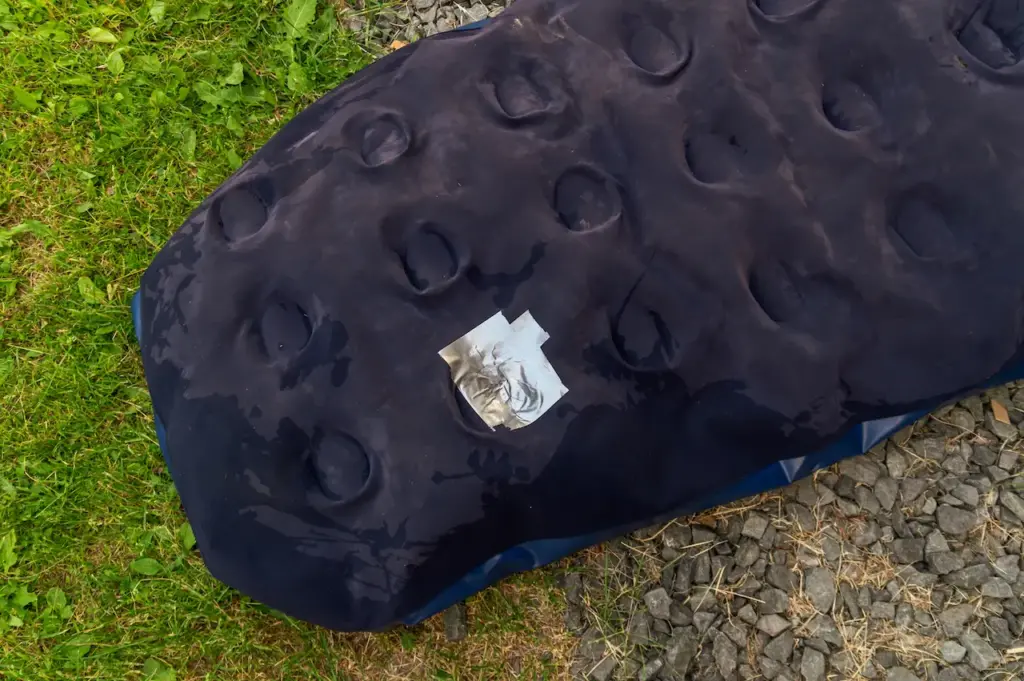
1) Use duct tape
Duct tape is a temporary fix because it will eventually lose its hold. It is a good solution when you need something quick. The adhesive on duct tape is designed for general-purpose use rather than for flexing plastic under constant pressure, which is why it slowly lets go.
You just need to cut a piece of tape large enough to cover the hole in your air mattress. Duct tape can be used on a deflated or inflated mattress, as long as the source of leakage is known.
2) Use nail polish
Nail polish, like duct tape, is not the best solution to fix your leaking air mattress.
Why? It can be removed because it loses viscosity over time.
Use nail polish to repair your leaky air mattress:
- To remove the flocking, sand the area where there is a leak.
- Wash the area thoroughly with water.
- Apply a nail polish over the hole, preferably a gel polish.
- To dry gel nail polish, use a UV lamp for 15-30 seconds.
- Repeat the process if it is not dried.
It suits pinprick holes only. A larger tear needs a patch that can bridge the gap.
3) Hot glue
It is possible to fix a leaking air mattress with hot glue, but this method is not recommended. Hot glue will not last as long as the other methods and may melt the soft area around the hole.
If you host a lot, it’s a good idea to have a patch kit on hand. I’d argue that’s the sensible call over any of these shortcuts, because a kit costs little and spares you a midnight scramble.
How to extend the life of your air mattress
Most air mattress damage is avoidable. A few habits make the difference between a bed that lasts and one that needs patching again and again.
- Wearing jewellery or shoes when using an air mattress is not recommended.
- Avoid putting anything sharp near or on the air mattress.
- When not in use, store the air mattress in an area that is cool and dry. Avoid storing the air mattress in direct sunlight or in a humid environment.
- Air mattresses should not be over- or under-inflated.
- Invest in a mattress cover: You should consider investing in a protector if you plan to use your air bed on a regular schedule. It will keep your mattress dry and clean and will extend its life.
- Regularly inflate your air mattress: Even if you don’t often use it, it is important to do so at least monthly. This will keep the material from cracking and drying out.
Overinflation stretches seams and valves, while underinflation lets bodies sag into folds that flex the plastic repeatedly. Both shorten the life of the bed. Loading matters too, so check the limits in our air mattress weight limit guide before a second person climbs on.
If a stored mattress picks up a musty smell, our ways to deodorise a mattress may help.
Wrapping up: repair or replace?
It is easy to patch an air mattress. Use the right materials and make sure you follow the instructions. If you host often, it’s a good idea to keep a patch kit on hand.
If your air mattress cannot be repaired, you may want to consider buying a new one. A bed with several leaks, split seams or cracked plastic is usually past saving. When you retire it, see whether it can be handled responsibly using our notes on recycling a mattress in Australia. Sweet dreams.
For independent guidance on sleep and wellbeing, the Sleep Health Foundation is a good starting point.


